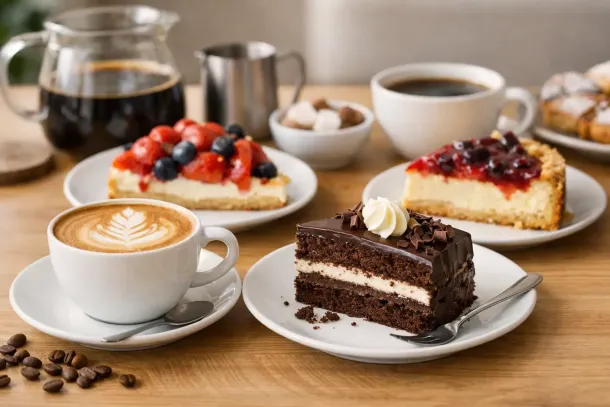
Anyone who's ever stood in front of a display case full of cake slices and then hesitated over coffee knows the little dilemma: the cake looks perfect, but only the right cup of coffee completes the moment. That's precisely why it's worth combining coffee and cake instead of simply serving them side by side. With the right choice, a sweet break becomes a harmonious indulgence – more refined, more balanced, and often surprisingly complex.
Combining coffee and cake: Why the vote counts
Cake brings sweetness, fat, fruit, acidity, or spices. Coffee, on the other hand, can be chocolatey, nutty, fruity, or intensely roasted. If the two are tasted together blindly, one can overpower the other. If they complement each other well, the coffee enhances the aromas of the pastry, absorbs its sweetness, or provides a clear contrast.
It's not rocket science, but a little attention makes a big difference. A very dark, bitter coffee can make a delicate vanilla cake taste harsh. A coffee that's too mild can easily get lost next to a rich chocolate torte. Good combinations arise where intensity, sweetness, and mouthfeel harmonize.
The most important rule when combining coffee and cake
The simplest rule of thumb is: the richer and more substantial the cake, the more prominent the coffee should be. Lighter cakes usually don't need an extremely dark roast, but rather clarity and elegance in the cup.
Then there's the question of whether you want harmony or contrast. Harmony means bringing similar notes together—for example, nutty coffee with nut cake. Contrast means setting something fresh or tart against a lot of sweetness, for example, a vibrant coffee with creamy cheesecake. Both can work wonderfully. It depends on whether the cake should be the focus or whether the coffee and dessert should create a new balance together.
Correctly interpreting sweetness, acidity, and roasted aromas
Sweetness in a cake dilutes the perceived sweetness of the coffee and makes bitterness more pronounced. That's why a coffee that is pleasantly smooth on its own suddenly tastes more intense next to a very sweet dessert. Fruity acidity in a cake can create an interesting interplay with fruity coffees, but if the proportions are wrong, it can also be too sharp.
Roasted flavors are especially effective when chocolate, caramel, nuts, or browned dough are involved. They shouldn't dominate delicate desserts. Once you understand this, you'll make much more confident choices.
Which coffees go best with which cakes
A well-balanced coffee with nutty and chocolatey notes often complements classic sponge cakes, Bundt cakes, or delicate marble cakes. It accompanies the cake rather than competing with it. This combination is particularly pleasant in the afternoon when you want something simple and comforting.
With cheesecake The coffee can be a bit more vibrant. The creamy, dense texture and light freshness of a good cheesecake pair very well with a coffee that has a clear structure. Fruity varieties with berries especially benefit from coffees that are not roasted too dark. Otherwise, the fruit flavors quickly become dull.
Chocolate cake demands presence. Here, the coffee can be stronger, deeper, and more cocoa-forward. Espresso or an intense Americano often work better than a very light filter coffee. The crucial thing is to keep the bitterness under control. Too much bitterness makes the combination difficult.
Fruit tarts, lemon cakes, or berry tarts benefit from a lighter, more precise flavor profile. A coffee with a delicate fruity note can beautifully complement these desserts. At the same time, restraint is key. If both the cake and the coffee are very acidic, the balance can easily become jarring.
Coffees with caramel and nougat notes are almost always a safe choice when paired with nut cakes, pecan tarts, or hazelnut desserts. This combination is generous, warm, and well-rounded. Especially during the cooler months, it creates a particularly harmonious moment of enjoyment.
Creamy cakes and desserts
Creamy cakes, mousse cakes, or dessert glasses feel soft and rich on the tongue. Coffee complements them, adding structure. A cappuccino can be a lovely choice, as the milk's sweetness enhances the dessert's character without overpowering the cake. However, with particularly sweet cream desserts, black coffee is often the more elegant option, as it leaves the palate feeling clean.
Traditional pastries and modern patisserie
For traditional pastries like apple pie, cheesecake, or crumb cake, familiar combinations often work best: a balanced coffee with a pleasant roasted aroma. Modern pastries with citrus, exotic fruits, or salted caramel allow for more experimentation. Here, the combination can be bolder, as long as one element clearly takes the lead.
Espresso, cappuccino or filter coffee?
Not only the bean, but also the preparation method influences how well coffee and cake pair. Espresso is concentrated, rich, and ideal for intense desserts. It goes well with chocolate, nuts, and caramelized flavors, but can easily overpower delicate cakes.
Cappuccino tastes softer and more approachable. The milk smooths out acidity and bitterness, making it a pleasant accompaniment to many cakes – especially in the morning or at a casual coffee gathering. However, with very sweet cakes, the added sweetness of the milk can be a bit too much.
Filter coffee often reveals nuances most clearly. It's frequently the most elegant choice for tarts, cheesecakes, fruitcakes, and light pastries. However, it also demands a high-quality coffee with a clean profile. If it's too weak or too bland, the combination loses its vibrancy.
Typical mistakes when combining
The most common mistake is choosing coffee based solely on strength. Strong coffee isn't automatically the right choice. A dark coffee won't solve every dessert problem, just as a mild coffee isn't always a safe bet. What's more important is the flavor profile of the cake and whether the coffee complements or balances it.
A second mistake is too much sweetness on both sides. Syrup in the coffee, plus a sugary cake – that quickly becomes overwhelming. It's better to let one element take center stage. If the cake is rich, the coffee should be relatively clear.
Temperature is also often underestimated. A very hot coffee next to a delicate cream cake initially masks all the nuances. A brief moment of patience helps. Once the coffee has cooled down a bit, the combination becomes much more precise.
This is how you find your personal favorite combination
Whether you're entertaining guests or want to treat yourself to something special, there's no need for complicated planning. First, ask yourself what the defining ingredient of the cake is: chocolate, fruit, nuts, cream, or spice. Then, choose the coffee either in the same vein or as a deliberate contrast.
Three approaches almost always work well for a safe start. Chocolate loves depth, fruit loves clarity, and nut loves warmth. From there, you can refine the flavors and experiment with preparation, milk content, or intensity. Especially with mixed dessert platters, it's often wiser to serve a versatile coffee rather than one with an extremely strong character.
When there are several cakes on the table, it's worth taking a look at the overall picture. A balanced Specialty Coffee It can bridge the gap without each variety needing its own companion. This is particularly practical when the occasion should remain relaxed but still appear stylish.
For everyday use, visitors and special occasions
In everyday life, the combination can be simple. A good cappuccino with a slice of cake is often perfectly sufficient, provided the balance and quality are right. Things get more interesting when you have guests: It quickly becomes apparent how much a well-thought-out coffee selection can change the overall impression of a set table.
For birthdays, invitations, or elegant dessert occasions, it's worth taking a closer look. A rich cake paired with the right coffee seems more complete, a delicate tart gains more definition, and even classic cakes appear more carefully chosen. It's precisely these small touches that make enjoyment so welcoming.
Anyone who thinks of high-quality pastries and specialty coffee together quickly realizes that both are more than just sweet and strong. At Zoomserie, this interplay is one of the beautiful details that makes a coffee shop moment or a celebration truly special.
You don't need to be a professional. A little attention to sweetness, texture, and aroma is often all it takes. The rest is a matter of taste – and that's precisely where the appeal lies. The best combination is ultimately the one where, after the last bite and the last sip, you pause for a moment and think: That's exactly how it should be.