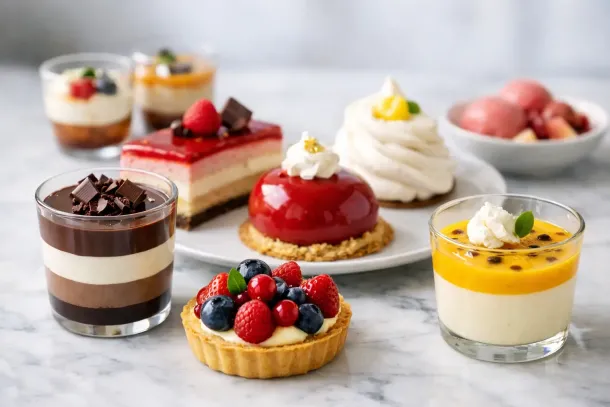
A dessert that's merely sweet rarely leaves a lasting impression. A spoonful that combines creamy richness, a crisp contrast, fresh acidity, and a delightful finish becomes the talk of the table. This guide to modern desserts will help you plan just such moments of indulgence – for a relaxed evening, a birthday, or a large celebration.
Modern patisserie doesn't mean everything has to be complicated, small, or experimental. It thrives on clear flavors, carefully chosen textures, and a presentation that brings joy. A good cheesecake can have a modern feel when fruit, crunch, and a light cream work together harmoniously. Even a classic cake benefits from being lighter, precisely decorated, and served appropriately for the occasion.
What defines modern desserts today
The difference begins with balance. Sweetness should entice, but not overwhelm. Therefore, fruity components, citrus notes, coffee, cocoa, or a delicate pinch of salt are among the best counterpoints. Especially after a rich meal, a dessert with berries, passion fruit, or lemon often feels more harmonious than a very rich chocolate cream.
Then there's the interplay of textures. A mousse can taste wonderful on its own, but with a crisp base, caramelized nuts, or a delicate biscuit, it becomes more exciting. Creamy, airy, crispy, and moist don't all have to be present at once. Two or three clearly recognizable elements are usually enough for a dessert to appear elegant rather than overloaded.
Visual appeal also plays a crucial role. Modern desserts should be eye-catching, but they don't need overly elaborate decoration. A neatly arranged fruit coulis, a few berries, chocolate decorations, or a carefully placed dollop of cream look more sophisticated than a plate where everything seems to be happening at once. Especially at parties, desserts are often photographed before they're cut – so good presentation is an integral part of the enjoyment.
Guide to modern desserts: First choose the occasion
Not every dessert is suitable for every occasion. Someone planning a long dinner for ten guests has different requirements than someone bringing a birthday cake to the office. Therefore, the most important question isn't: What looks the most beautiful? But rather: When, where, and for whom will it be served?
For a summer coffee break, light tarts, cheesecakes, fruity slices of cake, or dessert platters are particularly suitable. They are easy to share and look fresh even in warm weather. For a winter celebration, chocolate, nuts, caramel, and spices can take center stage. A moist cake or delicate pastry with dark cocoa then provides just the cozy depth one desires.
A personalized cake is often the centerpiece of a birthday celebration. Taste and impact are equally important: the size should suit the number of guests, the design the occasion, and the flavors the group. For a mixed group, a familiar flavor with a modern twist is a safe bet, such as chocolate with berries or vanilla with a fruity tang. Highly unusual creations can be exciting if the guests are curious to try them – however, for large parties, an approachable classic might be the better choice.
The right dessert mold for your guests
A cake makes a clear statement. It's ideal for cutting a cake, offering congratulations, or as a festive dessert highlight. Whether multi-tiered or individually decorated, it can visually dominate a celebration. For this to work, it needs to be cut at the right time and have enough space on the table.
Slices of cake, tarts, and cheesecakes are more versatile. They're perfect for an afternoon coffee, a small reception, or as a selection to suit different tastes. If you're unsure whether your guests prefer fruity, chocolatey, or creamy options, offering several varieties is usually a charming solution. Variety here isn't a compromise, but rather part of the experience.
Small patisserie, macarons, Donuts or cupcakes add a lively touch to the table. They can be enjoyed without much portioning and work well for casual get-togethers, in the office, or at parties where guests come and go. Their advantage is their variety. Their slight disadvantage: you should plan the quantity more generously, because "I'll just have one" quickly turns into two or three when these little treats are so delicious.
Dessert platters beautifully combine selection and presentation. They look inviting, don't completely relieve guests of the difficult choice, but make it a pleasure. Combine different shapes, colors, and flavors without placing too many similar items next to each other. Two chocolate desserts, three creams, and no fruity accent can quickly make a platter heavy.
Combine flavors wisely instead of wanting too much.
Modern desserts need a recognizable concept. Start with a main flavor – such as pistachio, chocolate, vanilla, coffee, or raspberry – and complement it with a suitable contrast. Pistachio harmonizes with lemon or raspberry, dark chocolate with sour cherry or orange, coffee with caramel and hazelnut. Vanilla becomes interesting with berries, apricot, or a subtle hint of spice.
Less is often more. If a dessert contains mango, coconut, lime, tonka bean, caramel, and white chocolate decoration, the flavor can become unclear. Two strong flavors and a textural accent usually tell a more compelling story. This also applies to cakes: A clear slice with easily identifiable layers creates more anticipation than an abundance that no one can name.
Also, consider the preceding meal. After pasta with a creamy sauce or a hearty main course, a fruity, light dessert is often welcome. After a simple lunch, however, dessert can be more rich and chocolatey. It depends on whether the dessert is meant to refresh, round off the meal, or deliberately make a grand entrance.
Quantities, timing and service without stress
For a celebration, it's worth having a little extra space. Don't just plan for the number of people, but also for the mood: Guests will order differently at an afternoon coffee gathering than after a large dinner. With a dessert selection, many will want to try several varieties. Smaller pieces and more variety are often more practical than a single, large portion per person.
Order special desserts Plan ahead, especially if personalization, a specific color scheme, or a larger quantity is required. Good planning frees up time on the day of the celebration. Arrange for pickup, transport, and refrigeration so that the decoration and consistency are perfect until serving. Cream and custard products shouldn't be left in warm environments for long, while cakes with a firm base are a bit more relaxed to handle.
The tableware also influences the overall impression. A cake needs a designated spot and a good knife, while small desserts look particularly elegant on simple platters. Serve coffee or espresso alongside, if your guests enjoy it: the subtle bitterness complements the sweet components and naturally prolongs the pleasure. At Zoomserie, cakes, pastries, and other sweet treats can be customized to suit any occasion – practical when you want to transform a simple idea into a harmonious dessert buffet.
Modern desserts can be personal.
A name on the cake, the birthday child's favorite flavor, or colors that match the celebration: personalization transforms a dessert into a thoughtful gesture. It doesn't have to be flashy. Often, a small detail that reflects the person or the occasion has a greater impact than an elaborate, unrelated presentation.
Hosts don't have to make everything themselves. The best celebrations rarely arise from perfect timing, but from taking time for the people at the table. Choose a dessert that reflects your style, suits your guests, and makes serving easy. If there's a brief moment of silence when the first cut is made, and then everyone reaches for their spoon at once, the dessert has done exactly what it was meant to do.